
He Wouldn’t Stop Criticizing Her
She didn’t cry when he said it.
That was the part that scared her most because it wasn’t that she felt nothing. It was that she felt so much that she just shut down.
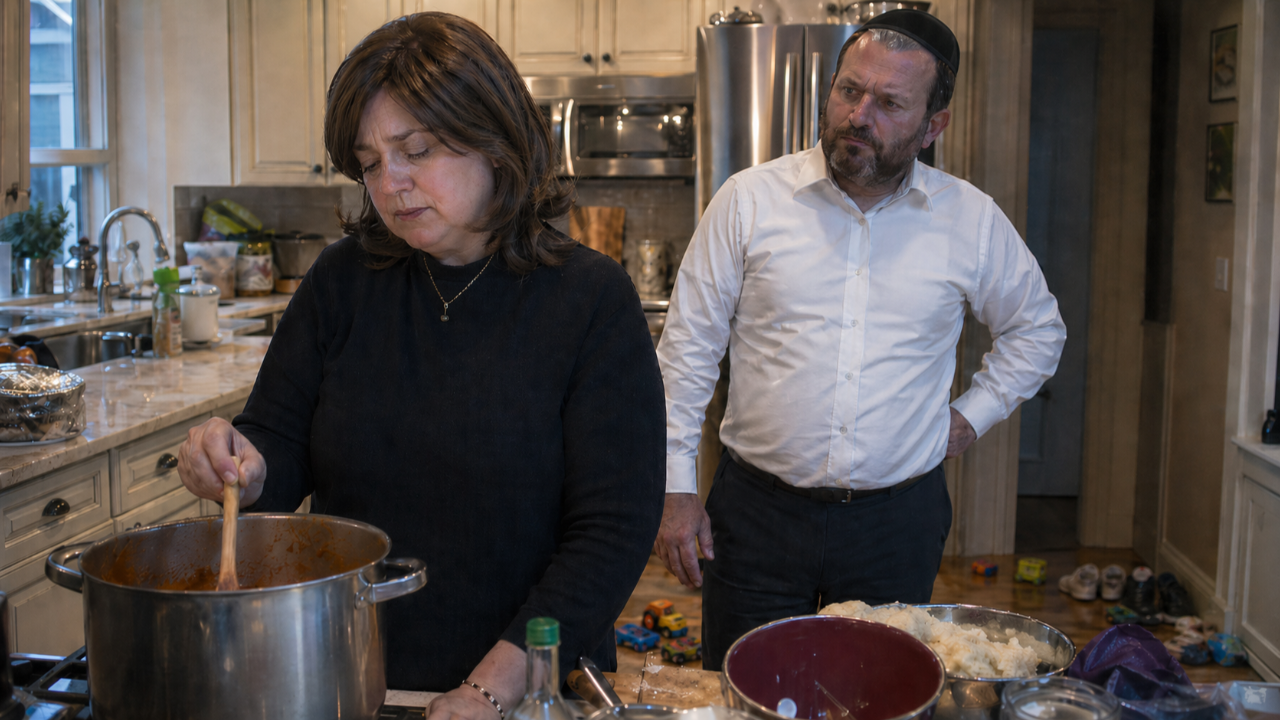
Mimi was standing at the stove on a Thursday night, stirring pasta sauce that was starting to stick to the bottom of the pot. Her eight-year-old was at the kitchen table with his homework open, her teenage daughter was leaning against the counter talking on the phone, and the baby was banging a spoon against his tray.
And then her husband walked in.
He looked around...backpacks half-open in the hall, a sweatshirt on the floor, toys and shoes strewn everywhere, a laundry basket near the hallway that had been waiting to go upstairs since four o’clock, an upside-down kitchen... and said, “This house is always a disaster. What do you even do all day?”
The spoon froze in Mimi’s hand. Her son stopped writing. Her daughter looked down. And Mimi felt that familiar rush of heat climb up her neck.
Not just anger.
Humiliation.
She wanted to turn around and scream, “What do I do all day? Are you serious? I take care of your children, your house, your supper, your life!”
And honestly, who could blame her?
All the work she had done all day had been erased in one sentence.
Mimi had been living with comments like that for years. Of course, there were normal moments, too. He provided for the family. He worked hard. He cared about the kids. He was not a monster. He was a man with his own stress, pressure, and pain.
But Mimi never knew which version of him was going to walk through the door, and that made her nervous system feel like it was always bracing. She listened for his footsteps and scanned his face before deciding whether it was safe to speak.
Mimi felt like she was on trial in her own home. That night, standing at the stove, everything in Mimi wanted to defend herself.
She could take the bait and enter the fight. Or she could resist it.
Her heart was pounding. Her face was hot. Her hand was still wrapped around the wooden spoon.
And then, very quietly, she said one word.
“Ouch.”
Not cold. Not dramatic. Not sarcastic. Just honest.
Her husband let out an exasperated sigh. “What? I’m just saying.”
He looked annoyed, like her one word had inconvenienced him.
And there it was again. More bait.
Mimi wanted to say, “No, you’re not just saying! You’re being mean. You need to apologize for how much that hurt.”
But this time, Mimi chose not to respond. Not because what he said was okay.
But because Mimi was beginning to understand that she did not have to hand him the remote control to her dignity.
Before, Mimi would have lost herself.
“What do you mean I do nothing? I was up with the baby twice last night. I got everyone out, ran to work, raced back, made supper, gave baths, helped with homework. You don’t appreciate anything!”
He would roll his eyes. “There you go again. Always making yourself the victim.”
And just like that, the kitchen would turn combustible.
That is the trap of bait.
It promises relief. It promises, “If I just say the right thing, he’ll finally understand.”
But most of the time, when he is in that state, he is not available to understand.
He is available to argue.
And that Thursday night, Mimi could feel the comment suffocating her. She knew she needed a minute before she could keep going.
She turned to her teenage daughter and said quietly, “Can you please watch the baby for a few minutes?”
Her daughter looked up and nodded.
Mimi gave herself permission to step away. She walked into her bedroom and closed the door. Mimi finally let the tears come.
In the past, after a comment like that, Mimi’s whole mind would swirl with condemnation as she replayed his comments. She would sob as she wondered, "What kind of husband talks like that?"
And those thoughts were understandable. But they kept her stuck. They kept her focused on his words, his tone, his criticism, his wrongness.
And the more she focused on him, the more powerless she felt.
That night, Mimi chose to focus on herself instead. After she cried for a few minutes, Mimi gently asked herself, “What do I want right now?” She washed her face. She took a few slow, deep breaths. Then she did a few jumping jacks. The movement helped her shed some of the heaviness that had enveloped her.
Nothing dramatic happened in that moment. Her husband did not suddenly walk in with flowers and an apology. The pain did not completely disappear.
But Mimi had not abandoned herself.
For years, Mimi thought she only had two choices: explode and defend herself, or swallow everything and pretend she was fine.
But there was a third option.
She could protect herself in the moment by walking away from the fight. Then she could feel the pain. And then she could choose how to soothe herself. She could choose who she wanted to be next.
That was completely different from stuffing it down.
At first, Mimi told me, “But if I don’t answer him when he is mean, won’t he think he can just talk to me however he wants?”
That fear is so real.
So many women worry that silence means permission. They worry that “Ouch” is too small. They worry that not defending themselves means they are weak.
But fighting for respect does not create respect.
Mimi was teaching herself, “I do not have to wait for him to be gentle with me before I respect myself.”
And over time, something began to change.
Her husband still had moments. He still had sharpness. But she was no longer feeding the fire. And because she stopped reacting to every jab, he had fewer places to go with it. His anger fizzled out more quickly.
One night, he started to make a critical comment and then stopped himself.
Mimi did not say, “Oh, so now you finally know how to talk?”
She just smiled warmly. It was small.
But small shifts create big changes in a marriage.
If you’re reading this and thinking, “Yes… this is exactly how I’ve been feeling. I feel criticized and put down, and I don’t know how to stop reacting,” you are not alone.
This is hard. Really hard.
And you do not have to figure it out by yourself.
You can schedule a free call with me here.
Let’s talk about how to bring back peace, dignity, warmth, and connection, even when things feel painful right now.
If you're ready to feel connected, seen, and cherished again, you don’t have to figure this out alone.
Stay connected with blog updates!
Join our mailing list to receive the latest blog posts.
Don't worry, your information will not be shared.