
Nobody Talks About...Having Nothing Left to Say to Each Other
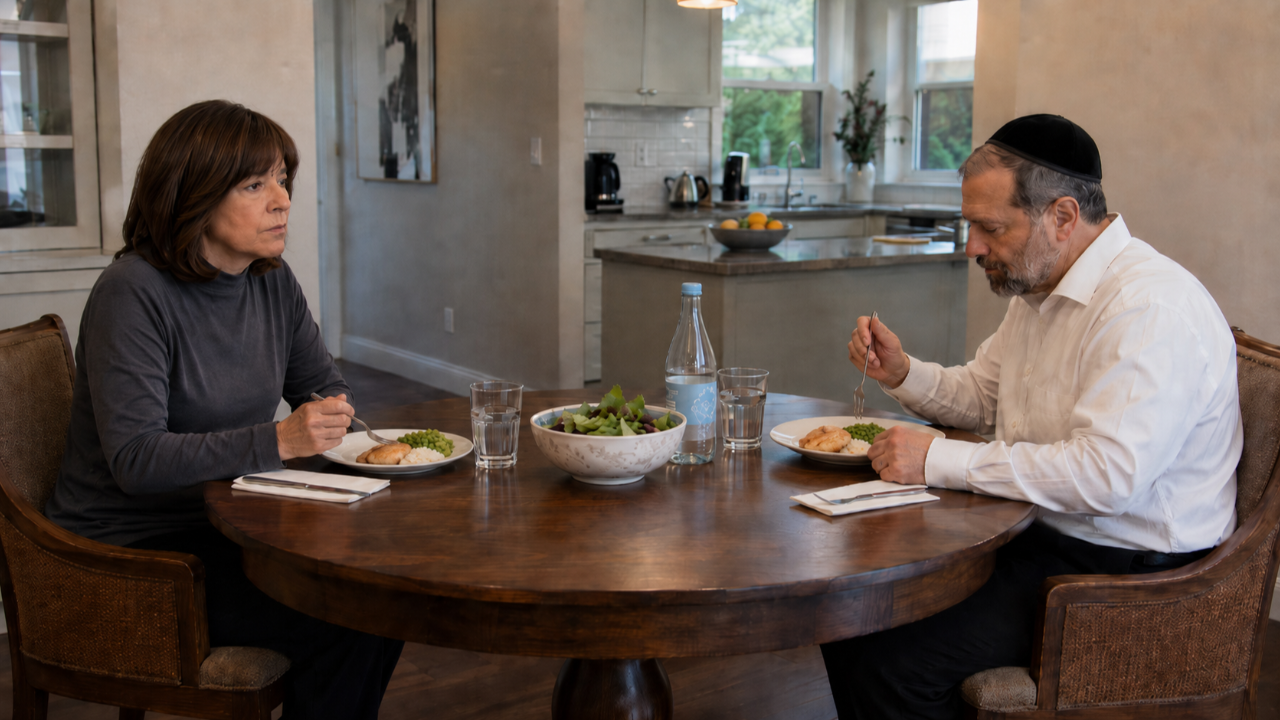
“Do you even notice?” Yaffa said, her fork clattering against the plate.
Moshe looked up slowly. “Notice what?”
“This dead silence. We have nothing to say, and you don’t even seem bothered by it.”
He blinked, genuinely confused. “I told you the chicken was good.”
That only made her angrier. “That’s not a conversation, Moshe.”
He put his fork down, and for one hopeful second, she thought maybe he would say something real. Maybe, You’re right. Or, I miss the kids, too. Maybe even, What happened to us?
Instead, he reached for his seltzer and said, “I don’t know what you want me to say.”
And there it was. The whole marriage, in one sentence.
Years ago, supper had meant noise and mess. Leah calling from upstairs that she couldn’t find her black shell and needed it now before rehearsal. Penina begging Yaffa to do kriah homework with her already. Shimon announcing at 9:43 that he needed poster board for his science fair the next day.
There had been camp forms on the counter, doctor appointments on the calendar, shidduch resumes open on the computer, robocalls coming in right when the soup was boiling over. There had always been something to handle. Someone to answer. A reason to keep moving.
Now there was the sound of Moshe chewing. Yaffa hated that she noticed it, but she noticed everything now. The scrape of his fork against the plate. The way he took forever to answer a simple question. The way he sighed when he sat down, as if even sitting required effort.
After supper, he would drift to the couch, phone in hand, scrolling as if the whole world lived inside that little screen.
That was his life, she thought bitterly.
Daven. Work. Eat. Phone. Sleep.
No interests. No excitement. No ambition.
His job hadn’t changed in years. Even his shoes looked like the same ones he had worn ten years ago. And now that the children weren’t home to soften the edges of him, all the things she used to push aside suddenly loomed large.
The way he never initiated anything. The way he seemed perfectly content to stay home and do nothing, while she felt like she was disappearing inside her own house.
They used to be busy with babies and bar mitzvahs, braces and after-school activities, boys coming home from yeshivah with laundry, girls crying over friendships, shidduchim, vorts, sheva brachos, apartment setups, and all the beautiful chaos that kept them talking.
Their conversations had been made of children.
“Did you call the menahel?”
“What did the shadchan say?”
“Leah needs new shoes.”
“Penina has a fever again.”
“Can you pick up Gershon on your way home?”
Now the children had their own kitchens, their own babies, their own lives. And Yaffa and Moshe were left sitting across from each other with nothing to hide behind.
One evening, Yaffa suggested they go for a walk. Maybe fresh air would help. Maybe walking side by side would feel less painful than sitting face to face. Maybe if they passed other couples, she could pretend they were one of those couples who walked together because they enjoyed each other’s company.
They walked three blocks before Moshe commented on a new porch someone had built.
“Mm,” Yaffa said.
Two blocks later, a car passed too fast. “People drive like maniacs,” Moshe said.
“Yeah,” Yaffa answered. Then silence again.
A breeze moved through the trees. Through an open window, Yaffa heard the noise of a younger family eating supper...chairs scraping, a child whining, a mother saying, “Please sit down already!”
She missed that. Not the chaos exactly. She missed being needed. Now there was space, and in that space, all she could feel was resentment.
Why doesn’t he talk? Why doesn’t he lead? Why doesn’t he care that we are so empty?
This is my life now, she thought. Cordial. Polite. Cold. Roommates with a kesubah.
And the more disappointed she felt, the more Moshe seemed to vanish. He stopped offering opinions. He retreated into his phone, his work emails, his comfortable silence.
Yaffa didn’t notice that around him, she had become sharp. A tight smile when he forgot to make a plan. A little jab about his phone. A quiet correction. A look. Nothing dramatic. Nothing anyone could accuse her of.
But Moshe felt it. He felt her disappointment before she even opened her mouth, so he did what people do when every move feels wrong. He moved less.
Nobody talks about what happens when the last child leaves and the marriage is suddenly standing there, uncovered. Nobody talks about how the children’s needs can become the music in the house, and when the music stops, you realize you don’t know how to dance with each other anymore.
And nobody warns you how terrifying free time can feel when your whole identity was built around being useful.
Yaffa finished work and went straight into helping. On Sundays, instead of asking, What would feel good to me? she asked, Who needs me?
She stopped at her married daughter’s house “just for a few minutes” and stayed three hours. She took her mother shopping. She brought soup to a kimpeturin.
Everyone praised her. “What would we do without you?”
And Yaffa smiled. But underneath the smile, she was starving. Not her body. Her body had coffee, crackers, a piece of kokosh cake with her tea.
But her spirit was running on fumes.
And a starving spirit does strange things. It becomes critical. It becomes resentful. It becomes obsessed with the sound of chewing. It stares at a husband across the table and thinks, You are the reason I feel empty.
That was the pain Yaffa brought to our coaching session. Underneath all that irritation was a woman who had spent decades pouring herself out for everyone else and had no idea how to pour anything back in.
“I don’t even know what I enjoy anymore,” she admitted quietly during one of our sessions.
The words embarrassed her. She was fifty-seven years old. A grandmother. A woman people called for recipes, rides, advice, chizuk, recommendations.
And she did not know what she liked.
She knew what everyone else liked. Moshe liked supper simple. Her mother liked errands early. Her daughter liked help but not advice. Her grandchildren liked stickers, ices, and when Bubby got down on the floor.
But Yaffa? She had no idea.
At first, taking care of herself felt silly. A walk alone sounded strange. A pottery class seemed almost embarrassing. Even reading a book just because she wanted to felt indulgent.
But then she thought about how her body felt when she forgot to eat lunch. Lightheaded. Irritable. Shaky.
She thought about her car the time she ignored the gas light because she was “too busy” and ended up stuck on the side of the road, hazard lights blinking.
No one called the car selfish for needing gas, and no one called her body dramatic for needing food.
Maybe her spirit had needs, too. Maybe resentment was the warning light.
So one Tuesday after work, Yaffa did not go straight to her daughter’s house. She sat in her car outside the office with her hands on the steering wheel and felt the familiar pull.
I should stop by. She probably needs help with bedtime.
Then she took a breath and drove to a small art supply store she had passed for years and never gone in. Inside, the shelves were lined with paints, brushes, sketchbooks, colored pencils, things with no practical purpose at all. No one needed her there. No one was waiting for her to fix anything.
She picked up a set of watercolor paints. The colors dazzled her. Deep blue. Burnt orange. Soft green. A purple that reminded her of the lilacs outside her childhood home.
She bought the paints before she could talk herself out of it.
That night, Moshe came home and found her at the kitchen table with a cup of tea, a piece of watercolor paper, and a very lopsided painting of a vase.
He stopped in the doorway. “What’s this?”
Yaffa said, “Nothing, it’s silly...I bought paints today.”
Moshe looked surprised. “You paint?”
“No,” she said, and then she laughed. “Clearly.”
He came closer, studied the crooked vase for a moment, and said, “It’s cheerful.”
When was the last time anything about her had felt cheerful?
The next week, she went walking with Chani from work. Not an errand disguised as exercise. A real walk, around the lake, with no agenda. She came home flushed and found Moshe at the table with his phone.
Usually, that would have irritated her immediately. This time, before irritation could take over, she said, “You won’t believe what Chani told me today.”
He looked up. She told him a story about Chani’s neighbor’s parrot that had learned to imitate the smoke alarm and sent the whole family running into the street twice in one week. Moshe laughed, and his face came to life.
She had forgotten what it felt like to see him as someone she could enjoy being around, not just a husband who disappointed her.
Another Sunday, Yaffa went to a lecture on Jewish women in history. She sat in the back, planning to leave early if anyone needed her. No one needed her, so she stayed.
The speaker told a story about a woman in Salonika who had supported an entire underground network of Torah learning with money from her embroidery business.
Yaffa came home alive with it. At supper, she told Moshe the story. He asked a question, then another. Then he told her something about his grandfather she had somehow never heard before. The conversation lasted fourteen minutes.
Yaffa knew because after he left to Maariv, she looked at the clock and cried. Fourteen minutes. Not about the kids. Not about a bill.
Just a conversation.
Something began to shift slowly. Moshe did not suddenly become a man with ten hobbies and a five-year plan. He still ate loudly. He still moved slowly. He still liked his phone more than she wished he did.
But Yaffa was no longer sitting across from him with an empty pit inside her, waiting for him to fill it.
She was feeding herself.
She started small: an exercise class on Tuesdays, a shiur on Shabbos afternoon, a walk on the boardwalk, a Sunday morning spent painting purple flowers that made her smile even though they looked nothing like flowers.
And the fuller she became, the less Moshe’s every movement offended her.
One Thursday night, he came home and said, “I saw there’s some kind of exhibit downtown. I don’t know if it’s your type of thing.”
My type of thing. Yaffa turned away so he wouldn’t see her eyes fill. She had a type of thing now. Little pieces of herself were coming back. And because she had something alive in her, there was something alive to bring into the room.
She brought more curiosity, and Moshe became a little more interesting. She stopped studying him like a disappointing report card, and he stopped feeling like he was failing before he even opened his mouth.
One regular Tuesday night, months after that painfully quiet supper, Yaffa and Moshe sat across from each other again at the same kitchen table. Moshe chewed a little too loudly.
Yaffa noticed, and then her eyes landed on the pink tulips she had bought for herself that morning, and on the article she wanted to tell him about. She noticed his tired eyes, the empty garbage can, the small kindness done without being asked.
And then Moshe said, “So what did you paint this week?”
Yaffa leaned forward. “You’re going to laugh,” she said, “I tried to paint a lemon, but it came out looking like a lumpy yellow rock.”
Moshe smiled. And this time, the silence after that was not cold. It was just a pause.
A place where something new could begin.
If you’re reading this and thinking, This is exactly how I feel... the house is quiet, the kids are busy with their own lives, and I don’t know how to feel close to my husband anymore... I would love to help you find your way back to yourself and to warmth in your marriage.
If you're ready to feel connected, seen, and cherished again, you don’t have to figure this out alone.
Stay connected with blog updates!
Join our mailing list to receive the latest blog posts.
Don't worry, your information will not be shared.