
Nobody Talks About...Dealing with Your Husband’s Children
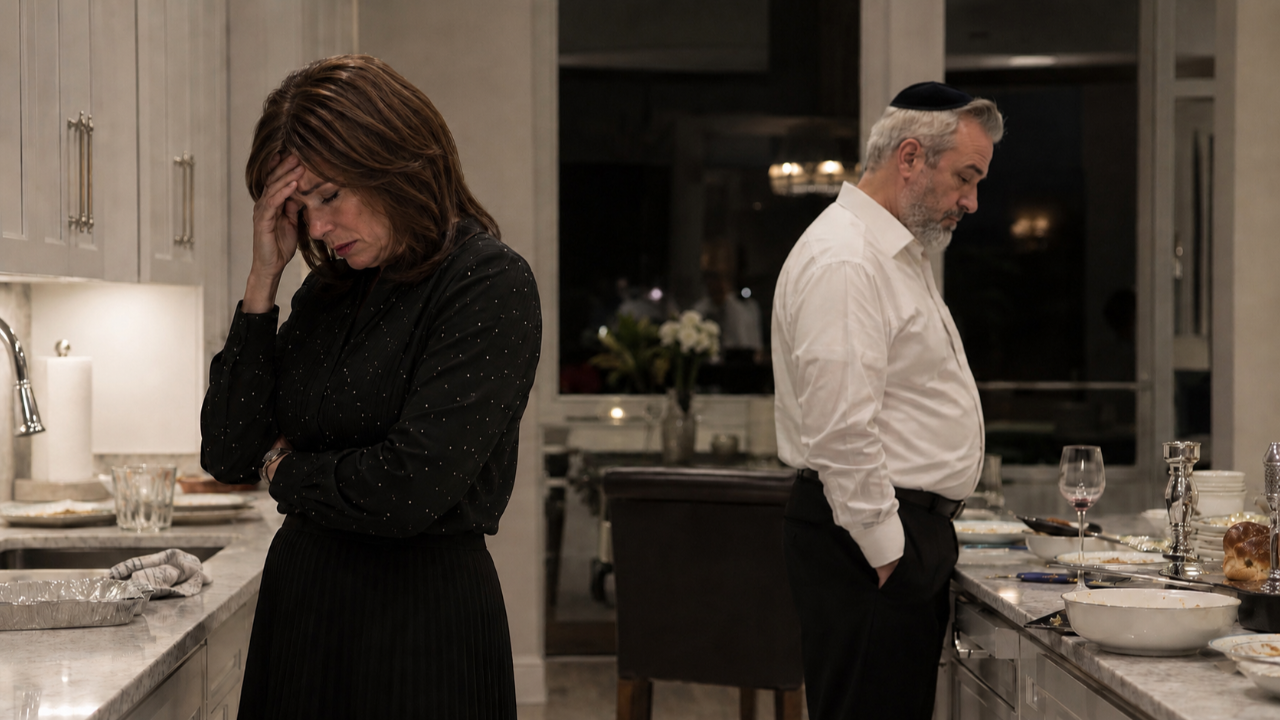
“Don’t tell me I’m overreacting.”
Rivky’s voice was shaking. His children had just left. The door had barely clicked shut, and Rivky could feel the anger rising in her chest.
“You saw what they did,” she said. “You saw how they spoke to me.”
He sighed. “Rivky,” he said carefully, “they’re my kids.”
And that was when something inside her snapped.
“I know they’re your kids. That’s the whole problem!”
The room went silent.
The Shabbos table was still half-cleared. A bentcher lay near his plate. There were crumbs under the chairs and a smear of grape juice on the white tablecloth. Everything looked like a normal Motzei Shabbos mess.
But it didn’t feel normal. It felt like their new marriage was cracking.
Because nobody wants to admit she married the man she loves… and then found herself loathing the children who came with him.
Not mildly. With a passion that scared her. By the time Rivky came to me, she was drowning in resentment.
“I know this sounds terrible,” she said, looking down at her hands. “But I hate when they come.”
Then the words came faster. “I hate the way I become. I hate how he changes around them. I hate that they have so much power in my marriage.”
And then she cried. The exhausted kind of crying. The kind that comes after months of trying to be mature, gracious, and understanding.
“I feel rejected in my own home,” she whispered. “I feel invisible. I feel like I don’t belong.”
Then she looked up at me and said the sentence she was most ashamed to admit.
“Sometimes I wonder if I made a terrible mistake.”
And the truth was, his children weren’t just awkward. They were cruel in that polished way that makes you feel crazy if you react.
His married daughter had walked into the dining room, looked around, and said, “Wow. You really changed everything.”
Not like a compliment. Like an accusation. Then she added, “I guess some people need to erase the past to feel comfortable.”
Rivky felt her face go hot.
His son barely looked at her and walked straight past her to his father. His daughter-in-law whispered something under her breath, glanced at Rivky, and laughed. When Rivky passed the kugel, his daughter took one bite and said, “Interesting. Tatty, do you like the way Mommy made it better?”
The word Mommy hung in the air. Rivky looked down at her plate. Her husband shifted uncomfortably but said nothing.
Then his son said, “No offense or anything, but it’s just weird seeing someone else sitting in Mommy’s seat.”
Rivky felt every part of her body go still. She had spent hours planning, cooking, cleaning, preparing. She had told herself, Be warm. Don’t take it personally.
And now she felt like a stranger in her own dining room.
Later, when Rivky stood up to clear, his daughter smiled and said, “Don’t worry, we know where things go. This was our house long before it was yours.”
That one landed the hardest. Because it was said with a sweet smile as if it was normal.
So after they left, Rivky presented the case. “Did you hear what she said? Why didn’t you say anything? Why do you never stand up for me?”
Rivky thought she was explaining her pain. But her husband heard something else.
He heard, “Your children are terrible.”
He heard, “You failed me.”
He heard, “Choose me over them.”
And he had no idea what to do, so he shut down. He got quieter. Colder. More protective of them. Less tender with her. And the colder he became, the more frightened Rivky felt.
See? He doesn’t care. I really am alone here.
So the next time, she explained harder. Cried harder. Proved harder. And every painful conversation became another brick in the wall between them.
By the time Rivky brought this into our coaching session, she was ready for a solution. She was tired of feeling so overwhelmed with resentment. When I mentioned gratitude as a formula for relieving her own pain, I could almost see her body tense. Because to Rivky, gratitude sounded absurd, like I was asking her to minimize the hurt.
It sounded like, “Don’t be so upset. Just focus on the positive.”
And when resentment was burning through her chest, that felt offensive. But real gratitude is not pretending that hurtful behavior is fine. It is not forcing yourself to love people you don’t yet feel safe with.
Gratitude is a way of turning your attention toward what is good, so resentment does not get to run the whole marriage.
We started with one question. “What is still good about your husband?”
Rivky stared at me. For a second, she looked almost scandalized. Then she looked away.
“I don’t know.”
We sat in the quiet. Then she said, “He did text me before they came to ask if I wanted anything from the store.”
That counted. A few moments later, she added, “He helped me set the table.”
That counted too. Then her face softened just a little.
“He took a walk with me Shabbos afternoon.”
She paused. “Maybe this is hard for him also.”
Rivky’s heart moved away from the threat long enough to see his fragility.
Gratitude did not magically make his children warm and welcoming. It did not make the comments acceptable. But Rivky decided to look for one small place where her husband showed care. Sometimes it was that he thanked her for cooking. Sometimes he brought her a little gift before they arrived. Sometimes it was that he looked at her gently after a hard comment, even if he didn’t know what to say.
At first, those things felt too small to matter. But they did matter. Because Rivky had spent so long looking for proof that he was failing her, she had almost missed the proof that he was trying.
Not perfectly. Not always in the way she wanted. But trying.
And each gratitude loosened one tight knot in her chest. It did not erase the hurt. But it made room for something else to exist next to the hurt.
Compassion. Softness. Connection. Hope.
And something shifted. One motzi Shabbos after his children left, Rivky was folding the tablecloth when her husband lingered in the doorway.
“I know this isn’t easy for you,” he said quietly.
Rivky almost missed it. It was not a dramatic apology. But it was the thing she had been begging for all along. A sign that he saw her.
And because her heart was softer, she could receive it. She looked at him and said, “Thank you for saying that. That means a lot to me.”
That night felt different. There was no courtroom with a pile of evidence. No husband trapped between the woman he married and the children he loves.
Just a fragile marriage with a little more breathing room.
Resentment said to Rivky, “If you stop proving how much they hurt you, no one will care.”
But gratitude whispered something braver. “You can walk through this with dignity and without turning your husband into the enemy.”
That does not mean you have to love his children overnight. It means you stop handing resentment the steering wheel.
If you’re reading this and thinking, “Yes… this is exactly how I’ve been feeling,” you don’t have to keep suffering or figure out how to protect your marriage alone.
You can schedule a free call with me here.
Let’s talk about how to soften the resentment before it hardens your marriage.
If you're ready to feel connected, seen, and cherished again, you don’t have to figure this out alone.
Stay connected with blog updates!
Join our mailing list to receive the latest blog posts.
Don't worry, your information will not be shared.