
Nobody Talks About Staying for the Kids
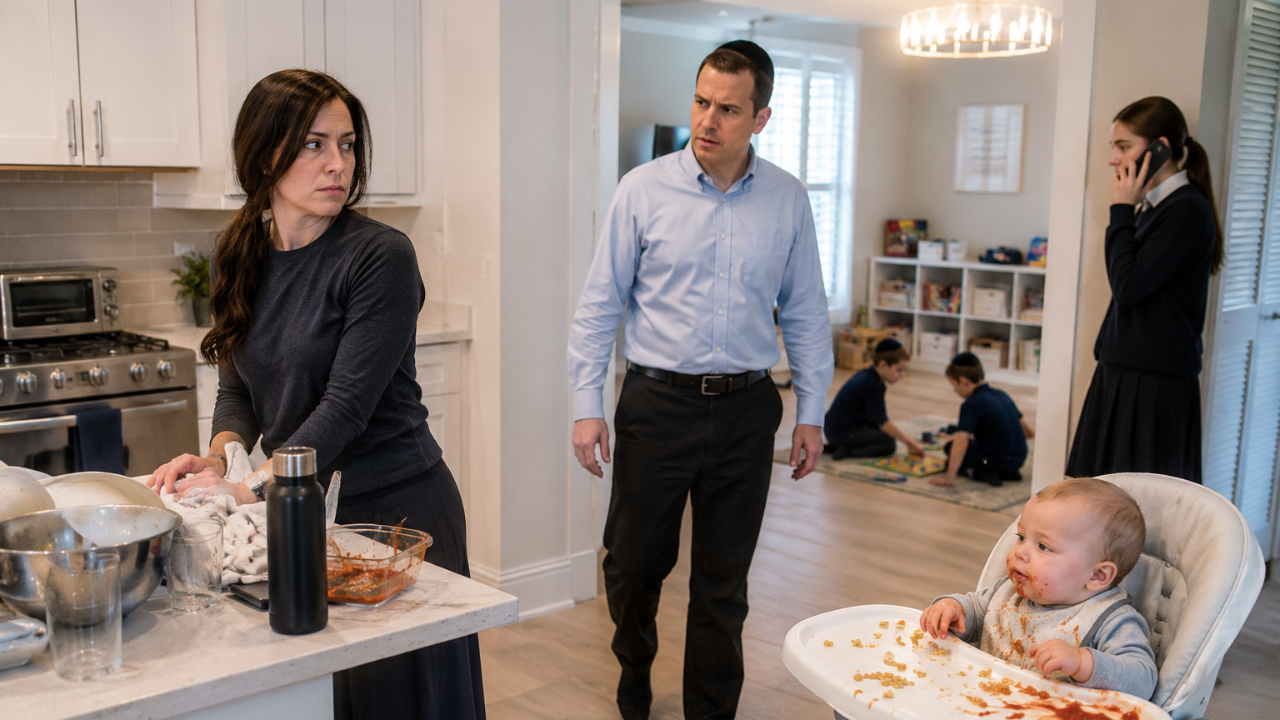
The fight started over a board game.
Not money.
Not chinuch.
Not some major life decision.
A board game.
Brocha was standing at the kitchen sink loading the supper dishes, while the noise around her kept rising.
In the playroom, two of the kids were arguing heatedly over a game, each one insisting the other had cheated. The baby sat in the high chair, happily tossing macaroni onto the floor one tiny piece at a time. Her daughter paced nearby on the phone, half-whispering, half-laughing, completely oblivious to the chaos surrounding her.
Then her husband walked in. He glanced toward the playroom and complained, “Can you please tell them to stop fighting? I just walked in, and I can’t take the screaming!”
Something inside Brocha snapped. “Then deal with them instead of standing there criticizing me.”
His face hardened and he seethed, “I wasn’t criticizing you. I just asked if you could calm them down.”
But Brocha was already too far gone. “Of course. You walk in, see everything falling apart, and somehow it’s still my job to fix every single thing.”
And within thirty seconds, they were no longer talking about the board game.
They were talking about how she never respects him.
How he never helps her.
How she always complains.
How he never listens.
How she feels alone.
How he feels attacked.
Now it was the same old fight they had in a hundred different ways. The one where Brocha felt crushed under the weight of everything she was managing, and he felt like every attempt to speak turned into another accusation.
“Did you pay that bill?” became a fight.
“What time are you coming home?” became a fight.
“Can you pick up milk?” became a fight.
“Why is the baby crying?” became a fight.
Then Brocha noticed that the playroom, which had been a screaming match only moments before, went quiet. One child slowly gathered the game pieces, eyes lowered, pretending to be busy. Her daughter ended her phone call and slipped into another room. Even the baby, still holding a piece of macaroni in his fist, paused and watched their faces.
That was the part that always got to Brocha.
Not just the yelling and sharp words.
It was the way the children already knew what to do: get quiet and stay out of the way.
And Brocha thought, not for the first time, “What are we doing to them?”
She and her husband had told themselves they were staying together for the kids. But lately, Brocha was starting to wonder what the kids were actually gaining from that.
Yitzi had become the fixer. The minute voices got sharp, he jumped up from the table. “I’ll clean up.” He was only nine years old, but somehow he had already decided it was his job to calm the house down.
Leahle, who had stopped sucking her thumb years earlier, started again. In the car. On the couch, when Tatty’s voice got tense.
Chaim had been pushing other boys at recess, saying mean things, grabbing the ball and refusing to let anyone else play.
And then came the questions Brocha dreaded. “Why is Tatty always mad?” or “Are you and Tatty getting a divorce?”
They were finding their own ways to survive inside it. That was what broke Brocha’s heart.
And it wasn’t only that the kids were witnessing the fighting. They were absorbing it. They were practicing it.
“Stop! You’re cheating again. You always cheat.”
“You’re so annoying. Nobody wants to play with you.”
“You’re such a baby. Everyone thinks you’re nerdy.”
And then, painfully, she started hearing that same sharpness directed at her and her husband too.
“You’re not the boss of me.”
“You don’t know what you’re talking about.”
They were learning that when you feel hurt, you attack.
When you feel scared, you control.
When you feel unheard, you get louder.
Brocha wanted her children to have a stable home. A mother and father under one roof. But she was starting to see that a whole home is not only about two parents living in the same house. It is also about the atmosphere the children breathe every day.
When Brocha came to coaching, she said, “We fight about everything. Literally everything. I don’t even know how to talk to him anymore.”
She wasn’t being dramatic. “I try to ask a normal question,” she said, “and it turns into a whole thing. So now I just don’t say anything. But then I resent him. And then it comes out anyway.”
That is the brutal cycle.
She swallowed it. She tried to keep the peace. Until one small comment came out with years of pain behind it. Then he reacted to her tone instead of the hurt underneath.
So she explained harder.
He defended harder.
She got louder.
He shut down or lashed back.
And the whole house held its breath again.
In coaching, Brocha wanted to know how to get him to finally understand.
How could she make him see how much she was carrying?
How could she explain how lonely she felt?
How could she get him to hear her without it turning into another fight?
Because that is where she was really stuck. She was trying to find the perfect sentence that would make him see how much he hurt her.
But more explaining often sounds like more criticism.
Even a reasonable explanation can land like an attack.
Even pain can come out sounding like blame.
Even “I just want you to understand me” can turn into another round of defending, proving, and hurting each other.
So we started with something that could lower the temperature before the fight caught fire.
Respect.
Not because he was right.
Not because he had “earned it” in that moment.
Not because Brocha’s pain didn’t matter.
But because disrespect pours gasoline on the fire.
Respect doesn’t excuse his behavior. It simply gives the conversation a chance to stay small.
Brocha began practicing one tiny sentence for the moments when she felt accused, criticized, or misunderstood:
“I hear you.”
Not because she agreed with him or had nothing to say. Not sarcastically. Not followed by, “but you also have to hear me.”
But because those three words gave his comment somewhere to land and enough space to lose steam instead of becoming another fight.
When he said, “Why is the house always such a mess?” her old response would have been, “Are you kidding me? Do you see what I do all day?”
This time, she took a breath and said, “I hear you.”
When he said, “Why is everything always so last minute?” her whole body wanted to defend herself because she had good reasons. But instead of launching into the whole list, she tried it again.
“I hear you.”
Then she walked away before she exploded. No proving her innocence.
Then she turned on some music while she finished wiping down the counter, just loud enough to give her something else to tune in to.
And for once, the moment passed without becoming a war. That was new.
One night, a few weeks later, her husband walked into the kitchen while she was cleaning up from supper.
The baby was cranky.
The counters were sticky.
School bags were still on the floor.
Two kids were supposed to be getting into pajamas, and somehow neither one was moving.
Brocha felt the old panic rise when he looked around. Here it comes...
But all he said was, “Looks pretty chaotic in here...would you like some help with bedtime?”
For a second, she almost didn’t know how to answer.
She took a breath and said, “Yes. That would be amazing.”
Brocha told me, “It sounds so small, but it felt huge. He offered to help, and I didn’t turn it into a fight with a snarky comment. We had a normal conversation.”
That is how peace often comes back. Not in one perfect heart-to-heart. Not because every issue is suddenly solved.
But because one person stops throwing matches into dry grass.
One respectful response.
One “I hear you.”
And the children witness that too. They witness a mother who is no longer helpless inside the tension. They witness a home where not every mistake becomes a battle. They witness dignity.
Staying for the kids is not only about staying in the same house.
It is about asking: What atmosphere are they inhaling? What are they learning happens when people feel hurt?
And the most hopeful part is this: The culture can change.
Even if you are the only one making changes right now.
Even if he still sounds defensive.
Even if you still feel hurt.
Even if your marriage has felt like a minefield for years.
Small shifts create big changes in a marriage.
If you’re reading this and thinking, “Yes… this is exactly how I’ve been feeling,” you don’t have to figure out how to stop fighting about everything alone.
You can schedule a free call with me here.
Let’s talk about how to bring respect and emotional safety back into your home.
If you're ready to feel connected, seen, and cherished again, you don’t have to figure this out alone.
Stay connected with blog updates!
Join our mailing list to receive the latest blog posts.
Don't worry, your information will not be shared.