
Nobody Talks About...How Lonely It Feels When He Never Opens Up
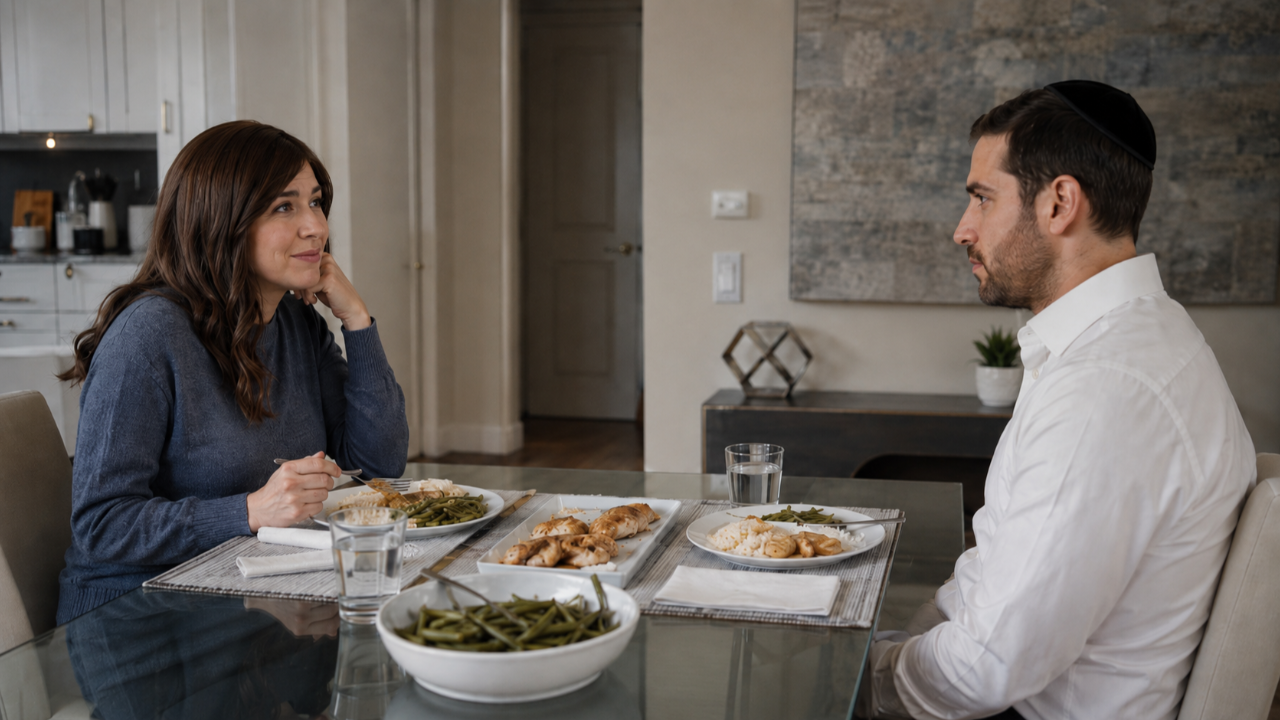
The kids were finally asleep. Chany carried the plates to the table and sat down across from Ahron.
All day, she had been looking forward to this. No one asking for a drink. No one climbing onto her lap. No lunches to pack or pajamas to find or little voices interrupting every other sentence.
“So…” Chany said, smiling at him hopefully. “How was your day?”
“Good,” Ahron answered casually, reaching for his water.
Chany waited, hoping he would add something.
Ahron took another bite of chicken while Chany searched for another way into the conversation.
“Anything interesting happen?” she asked, trying to keep her voice light.
Ahron paused as though he were genuinely considering the question. “Not really,” he said with a small shrug.
Chany felt the first flicker of disappointment. “Did you end up speaking to your brother?” she asked, refusing to give up yet.
“Yeah,” Ahron answered simply, still eating.
“And how is he?” Chany pressed harder to keep the conversation alive.
“He’s fine,” Ahron said matter-of-factly.
This is painful.
She had been saving little things all day to tell him. Something funny her daughter had said. A conversation she’d had with her coworker.
But she didn’t want to perform an entire conversation by herself. She wanted him to open up too. A thought, a story, an opinion.
Anything.
This wasn’t how Chany had pictured marriage. She had imagined her husband becoming her best friend and confidant. The person she couldn’t wait to tell things to and who couldn’t wait to tell things to her.
Instead, some nights she felt like she was sitting across from a man she couldn’t quite reach.
“What are you thinking about?” Chany finally asked, studying his face.
Ahron looked up, surprised by the question. “Right now?”
“Yes,” Chany said, trying not to sound as frustrated as she felt.
Ahron considered it for a moment and shrugged. “Nothing, really.”
Something inside Chany sank.
How can you be thinking about nothing?
She had approximately forty-seven thoughts running through her head at any given moment.
“Don’t you ever feel like talking about…stuff?” Chany asked, waving one hand helplessly.
Ahron smiled, genuinely puzzled. “What stuff?”
She wanted to know what worried him. What excited him. What he thought about when he couldn’t sleep. What he hoped their life would look like in five years. Whether someone’s comment had hurt him. Whether he ever felt insecure or overwhelmed or scared.
She wanted to know the part of him nobody else got to see.
And the more Chany focused on what Ahron wasn’t giving her, the more emotionally distant he seemed.
Is this always going to feel this lonely?
She imagined another five years of pulling conversation out of him one question at a time. Ten years. Twenty.
The thought made her chest ache.
Then one evening, their son, Yaakov, was eating a cookie at the kitchen table when he started scratching at his neck.
“Mommy, my mouth feels funny,” Yaakov said, looking up at her with a confused expression.
Chany spun around.
Red blotches were spreading across his face.
For one second, she just stared. Then she saw his lips.
“Ahron!” Chany screamed, her voice sharp with panic. “Ahron, come here!”
Ahron came running into the kitchen, took one look at Yaakov, and immediately became focused.
“Yaakov, come sit right here with me,” Ahron said calmly, pulling out the chair beside him.
Chany’s heart was pounding so hard she could hear it in her ears.
“What’s happening? Is his throat closing?” she blurted, grabbing her phone with shaking hands. “Should I call Hatzalah? Ahron, should I call—”
“I’m calling,” Ahron told her evenly as he reached for the EpiPen.
Chany watched him give Yaakov the EpiPen and Benadryl, and suddenly the kitchen seemed to tilt. Her head felt light. Her hands went cold.
What if it doesn’t work? What if he stops breathing? What if they don’t get here fast enough?
“I think his face looks worse,” Chany said, her words tumbling over one another as she stared at Yaakov. “Does his face look worse to you? Ahron, I think it looks worse. What if his breathing—”
“Chany, Hatzalah is coming,” Ahron told her firmly, looking straight into her frightened eyes. “He got the EpiPen. We’re taking care of him.”
She nodded, but she could barely absorb what he was saying.
By the time the Hatzalah members rushed through the door with their bags, Chany felt as though she were watching everything through a tunnel.
“He had a cookie, but he’s had that kind before, or I think he has, and then he said his mouth felt funny, and I saw the rash, and I don’t know if maybe there was something in it, and his lips looked, do his lips look swollen to you?” Chany babbled, barely stopping long enough to breathe.
Ahron stepped beside her.
“He started saying his mouth felt funny about five minutes ago,” Ahron explained calmly to the Hatzalah member. “Then we noticed the hives. I gave him the EpiPen right away.”
His sentences were short, clear, useful.
When Chany started repeating that Yaakov's face looked different, Ahron turned toward her, his expression steady.
“They’re taking care of him,” Ahron said quietly, meeting her eyes. “He’s okay.”
And somehow, even though Chany’s own thoughts were flying everywhere, Ahron wasn’t flying with them.
He was steady. She could almost feel herself grabbing onto that steadiness.
Later, after Hatzalah had left and Yaakov was sleeping soundly, Chany stood alone at the kitchen sink.
Her body still felt wrung out from the adrenaline.
She stared at the water running over a plate and replayed the afternoon.
Her shaking hands. Her mind racing toward every possible disaster. Her words coming out so fast she could barely organize a sentence.
And Ahron.
Calm enough to give Yaakov the EpiPen, to clearly tell Hatzalah exactly what had happened, to answer their questions while she could barely think.
Calm enough for her to lean on when she couldn’t steady herself.
And for the first time, Chany wondered whether the quality she kept calling emotionally distant might look very different from another angle.
Once she noticed it, she started seeing it everywhere.
A week later, Ahron spent almost an hour on the phone trying to fix an insurance problem. He was transferred three times. One representative contradicted the previous one. Then he was put back on hold.
Chany was getting irritated just listening from the other room.
These people are unbelievable. How is he not losing it?
When yet another representative gave Ahron an answer that made no sense, he rubbed his forehead but kept his voice even. “Okay,” Ahron said patiently into the phone. “Can you please tell me what the next step is?”
Chany stared at him. If she had been on that call, the entire house would have known about it.
Yet Ahron somehow dealt with frustrating, complicated people without letting their incompetence hijack his mood.
Then she began noticing what happened when she was the one unraveling.
One night Chany walked into their bedroom completely depleted. “I cannot handle one more person needing something from me,” she announced, dropping onto the edge of the bed as tears filled her eyes.
Within minutes, she was crying about the kids, a comment a neighbor had made, and how overwhelmed she felt about getting the kids ready for school with Yom Tov right around the corner.
Ahron didn’t tell her she was overreacting. He didn’t get agitated because she was agitated.
He listened.
When Chany finally ran out of words, Ahron stayed quiet for a moment, letting the silence settle.
“That sounds like a really hard day,” he said softly.
Chany looked at him. And suddenly she saw something she had missed hundreds of times before.
His calm wasn’t always a wall between them.
Sometimes it was the thing holding them together.
The next morning, Chany poured Ahron coffee and sat beside him.
“I was thinking about what happened with Yaakov,” she said, feeling unexpectedly emotional.
Ahron put down his coffee and looked at her.
“I was terrified,” Chany told him, her voice softening. “And you stayed so calm. I felt like I could lean on you because you knew what to do. I’m really grateful for that.”
Ahron’s shoulders relaxed, and a small smile appeared.
“Of course,” he said quietly, looking almost surprised by her words.
So Chany kept noticing. She noticed how he handled pressure. How slowly he got angry. How difficult it was to pull him into somebody else’s drama.
How safe that steadiness actually made her feel.
And she started telling him. Not vague compliments.
Specific gratitude for the very qualities she had been overlooking because she was so busy measuring him against the husband she thought he should be.
Slowly, something shifted.
Not Ahron.
Chany.
When she looked across the table now, she didn’t see only what was missing. She saw her rock.
A few weeks later, Chany and Ahron were sitting down for supper when Ahron seemed quieter than usual. Chany noticed it, but this time she didn’t start asking questions to pull something out of him. She kept eating.
A few minutes later, Ahron put down his fork. “Work was rough today,” he said, exhaling slowly as he stared at his plate.
Chany looked up, surprised. “Oh?” she said softly, resisting the urge to immediately ask five questions.
Ahron was quiet for a moment, as if deciding whether to continue. “I’ve been working on this project for weeks,” he said finally, frustration creeping into his voice. “And today my boss basically dismissed the whole thing in front of everyone.”
Chany felt herself go completely still. Ahron never talked about things like this.
“I know it shouldn’t bother me so much,” he continued, rubbing his forehead. “But it did. I walked out of there wondering if he even values what I do.”
Chany felt something tighten in her throat. He was letting her see something that had hurt him.
“I can understand why that would bother you,” Chany said gently, keeping her voice quiet instead of rushing in to fix it or ask for more.
Ahron nodded, his expression still troubled. “I don’t know,” he said after a pause. “Sometimes I wonder if I’m even going anywhere there.”
Chany sat across from him and listened. And somewhere inside her, she realized that this was the kind of conversation she had spent years wishing for.
Only she hadn’t made it happen by pushing harder. She hadn’t explained why he needed to communicate more or tried to turn him into a more emotional version of himself.
She had started appreciating the man who was already there.
And as she stopped treating his quietness as something wrong with him, there was more room for Ahron to come toward her on his own. More room for her to discover that quiet didn’t mean he had no inner world.
And now, little by little, he was inviting her into it.
If you recognize yourself in Chany, if you love your husband but sometimes ache for a closeness that doesn’t seem to come naturally to him, you may not need a different husband.
You may just be missing something beautiful about the one sitting across from you.
If you long for more emotional connection, you don’t have to figure it out alone. I’d love to support you.
You can schedule a free Marriage Breakthrough Session with me here.
Let’s talk about what small shifts could help you experience more warmth and connection with the husband you already have.
If you're ready to feel connected, seen, and cherished again, you don’t have to figure this out alone.
Stay connected with blog updates!
Join our mailing list to receive the latest blog posts.
Don't worry, your information will not be shared.