How to Say “I’m Scared” Without Pushing Him Away
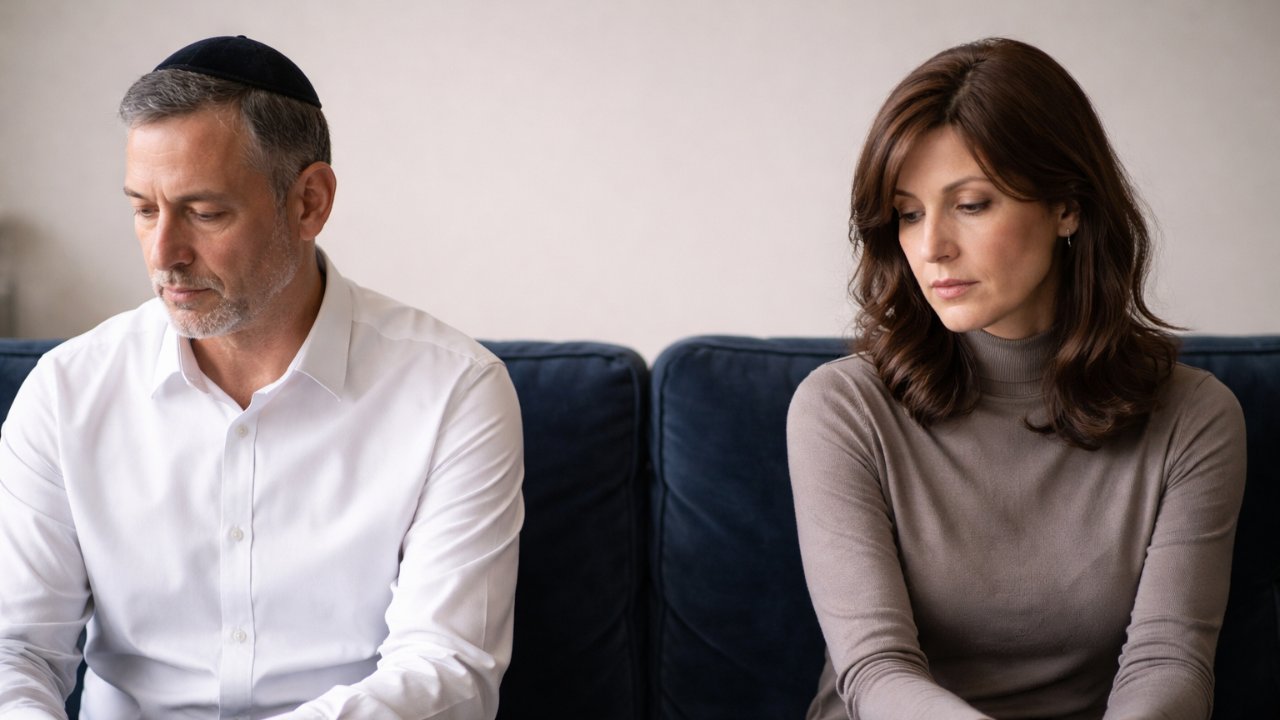
Ahuva lay awake, staring at the ceiling long after the house was quiet.
Her mind kept circling the same terrifying thought:
What will be with Moishy?
Their son had started drifting and changing.
Different friends. A tone she didn’t recognize. Questions that felt less curious and more defiant. A heaviness she felt, but couldn’t lift.
She felt an agonizing powerlessness.
Not knowing how to help and protect him.
Not knowing what the future would hold.
The fears we carry alone
At night, her thoughts widened.
Will he get kicked out of yeshiva?
What did we do wrong?
How will it impact the other kids?
She didn’t say any of it out loud.
Not to her friends.
Not to her family.
Not even to her husband.
Because this fear felt too big.
Too shameful.
Too dangerous.
She didn’t know how to say it without sounding panicked, dramatic, or weak.
So she did what so many women do.
She stayed strong.
She stayed capable.
She stayed “fine.”
And she felt completely alone.
Ahuva worried silently.
She carried the weight in her body and her thoughts.
And she grew frustrated with her husband because he seemed able to breathe when she couldn’t. Why wasn’t he panicking the same way she was?
“He seems so calm,” she said. “It makes me feel like I’m crazy… or like he doesn’t care. Like I’m the only one who sees how serious this is.”
She felt emotionally miles away from him.
The risk of vulnerability
In our work together, we talked about vulnerability, not as falling apart, but as letting someone else stand with you inside the uncertainty.
Somewhere along the way, many of us learned that connection comes from competence.
From having it together.
From not needing too much.
From protecting ourselves by staying guarded.
Vulnerability feels dangerous because for many women, it has been dangerous.
Your fears were minimized.
Your worries were mocked.
Your doubts were weaponized later.
So you learned to keep your soft places hidden.
But here’s the paradox:
The very thing you’re protecting yourself from…
is the very thing that creates real connection.
So late that night, after the house had finally gone quiet, Ahuva sat across from her husband at the kitchen table. Instead of launching into concerns or problem-solving, she exposed her fears.
Her throat felt thick, like the words might get stuck if she tried to push them out.
Would her husband tell her she was overreacting?
Imply that she was the reason Moishy was spiraling?
What if it got thrown back at her in the next argument?
She stared at the floor for a long moment, then finally spoke.
“I’m so scared,” she said, her voice shaking and tears streaming down her face.
“I don’t know what to do for Moishy. I feel like a total failure as a mother.”
She felt exposed. The words hung there, fragile.
She waited. For advice. For him to tell her she was overreacting.
Instead, he was quiet for a moment.
Surprisingly, her husband didn’t rush to reassure or criticize her. Instead of pulling away…he softened.
He exhaled slowly, his shoulders sagging just a bit. He looked older in that moment. He looked down and said quietly, “I’m scared too. And I don’t have answers.”
For the first time, she saw the fear he had been holding back.
They didn’t suddenly have answers. Their son didn’t magically stop struggling.
But it did make them allies.
Ahuva told me, “For the first time, I felt like we were on the same side. Like we were facing this together.”
Why vulnerability connects
When a husband and wife become each other’s confidants, something special forms.
You’re no longer adversaries trying to cope differently.
You become allies in the middle of uncertainty.
Keepers of each other’s secrets.
Sources of comfort when there are no answers.
Believing you will each treat each other’s weaknesses carefully.
That is real connection. That kind of connection is rare.
There is a unique kind of closeness that comes from knowing:
My fears are safe with you.
My doubts won’t be used against me.
My weakness won’t make me unlovable.
Vulnerability didn’t make her smaller in his eyes.
It made her real. And allowed him to also feel safe being real.
This is what it means to be true partners.
You become a team, even when the situation feels desperate.
Not because you figured everything out. But because you faced it together.
That bond sustains a marriage through the hardest situations.
Vulnerability isn’t weakness.
It’s an invitation.
An invitation to let your husband be your ally.
And sometimes, that alone changes everything.
If you’re lying awake at night, worried about a future you can’t control, and you’re afraid that saying it out loud will make you feel exposed or unsafe, you deserve support.
Let’s talk about how to feel safely supported.
If you're ready to feel connected, seen, and cherished again, you don’t have to figure this out alone.
Stay connected with blog updates!
Join our mailing list to receive the latest blog posts.
Don't worry, your information will not be shared.